A Guide to Choosing the Right Battery Charger
Selecting the right battery charger isn't as simple as picking the cheapest option on the shelf. The wrong charger can damage your battery, underperform when you need it most, or even create safety hazards. Whether you're charging a car battery, maintaining a boat, powering solar systems, or managing a fleet of vehicles, this comprehensive guide will help you choose the perfect charger for your specific needs.
Before buying your charger, these are the starting questions to consider:
-What battery technology do I need to charge?
-What are my voltage requirements?
-What is my battery recommended or maximum charging current needs?
-Do I need specific IP rated charger?
Will I need additional accessories to ensure safe and secure charging, such as extenders or different connectors?
Understanding Battery Technology: The Foundation of Your Choice
The single most critical factor in choosing a battery charger is matching it to your battery's chemistry. Different battery technologies require different charging profiles, voltages, and algorithms. Using the wrong charger can permanently damage your battery or reduce its lifespan significantly.
Lead-Acid Batteries
Flooded/Wet Cell Lead-Acid: These traditional batteries contain liquid electrolyte and require regular maintenance. They're commonly found in vehicles, boats, and backup power systems.
Charging Requirements:
- Standard charging voltage: 14.4V - 14.8V (for 12V batteries)
- Can tolerate higher charging currents
- May require equalization charging periodically
- Produces hydrogen gas during charging (ventilation required)
AGM (Absorbent Glass Mat): AGM batteries are sealed, maintenance-free, and more sensitive to overcharging than flooded batteries. They're popular in modern vehicles, RVs, and marine applications.
Charging Requirements:
- Lower charging voltage: 14.4V - 14.7V (for 12V batteries)
- More sensitive to overcharging
- Benefits from temperature compensation
- Requires precise voltage control
Gel Batteries: Gel batteries use silica to suspend the electrolyte, making them extremely sensitive to charging voltage.
Charging Requirements:
- Lower charging voltage: 14.0V - 14.2V (for 12V batteries)
- Very sensitive to overcharging
- Slower charging rates recommended
- Must have gel-specific charging profile
Calcium Batteries: Modern maintenance-free batteries often use calcium in their construction, requiring slightly different charging profiles.
Charging Requirements:
- Higher charging voltage: 14.8V - 15.0V (for 12V batteries)
- Benefits from multi-stage charging
- Common in newer vehicles
Lithium Batteries
Lithium Iron Phosphate (LiFePO4): The most common lithium battery for automotive, marine, and solar applications.
Charging Requirements:
- Charging voltage: 14.2V - 14.6V (for 12V batteries)
- Requires Battery Management System (BMS) compatibility
- Temperature monitoring essential
- Cannot be charged below 0°C
- Needs lithium-specific charging profile
CRITICAL: Never use a lead-acid charger on lithium batteries unless it has a dedicated lithium mode. The charging profile is completely different, and incorrect charging can create a hazardous situation.
Deep Cycle vs. Starting Batteries
Starting Batteries: Designed to deliver short bursts of high current to start engines.
Charging Needs:
- Can handle higher charging currents
- Faster charging is acceptable
- Standard automotive charging profiles work well
Deep Cycle Batteries: Built to provide steady power over extended periods and withstand repeated deep discharges.
Charging Needs:
- Benefit from slower, controlled charging
- Multi-stage charging extends battery life
- Temperature compensation recommended
- Equalization charging beneficial for flooded types
Battery Voltage: Match Your System
Battery chargers are designed for specific voltage systems. Using the wrong voltage charger will not work and may cause damage.
Common Voltage Systems:
6-Volt Systems:
- Older vehicles and vintage cars
- Some golf carts and floor scrubbers
- Classic motorcycles
- Antique tractors
12-Volt Systems:
- Most cars, motorcycles, and light vehicles
- RVs and caravans
- Boats and marine equipment
- Solar power systems (common)
- Backup power supplies
24-Volt Systems:
- Heavy trucks and commercial vehicles
- Buses and coaches
- Large boats and yachts
- Industrial equipment
- Some solar installations
36-Volt and 48-Volt Systems:
- Golf carts and utility vehicles
- Large solar power systems
- Industrial forklifts and material handling
- Electric boats
- Off-grid power systems
IMPORTANT: Always verify your battery voltage before purchasing a charger. Some chargers can handle multiple voltages (6V/12V or 12V/24V), which offers flexibility if you have different equipment.
Battery Size and Capacity: Matching Amperage
Battery capacity is measured in Amp Hours (Ah), and your charger's output amperage should be matched to your battery size for optimal charging.
The 10% Rule
A general guideline is that your charger's amperage should be approximately 10% of your battery's Ah rating for optimal charging speed and battery health.
Examples:
- 50Ah battery → 5A charger
- 100Ah battery → 10A charger
- 200Ah battery → 20A charger
Charger Amperage Categories:
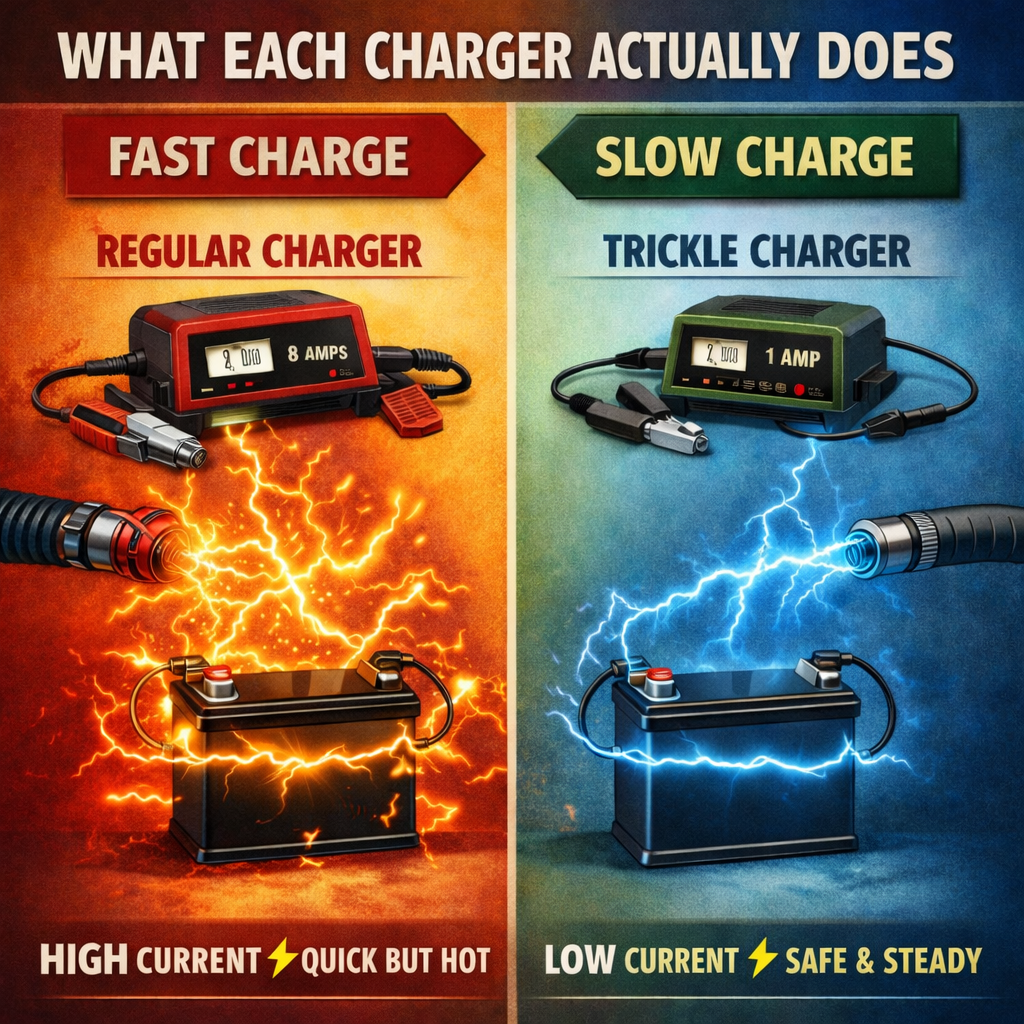
Trickle Chargers (0.5A - 2A): Best For:
- Motorcycle batteries (5Ah - 20Ah)
- Small lawn equipment batteries
- Long-term battery maintenance
- Classic cars in storage
Pros: Gentle on batteries, safe for extended connection, affordable Cons: Very slow charging, not suitable for dead batteries
Standard Chargers (4A - 10A): Best For:
- Car batteries (40Ah - 80Ah)
- Small marine batteries
- Caravan auxiliary batteries
- General maintenance charging
Pros: Reasonable charging speed, suitable for most consumer applications Cons: Slow for large batteries, may not recover deeply discharged batteries
Heavy-Duty Chargers (15A - 30A): Best For:
- Large car and SUV batteries (80Ah - 120Ah)
- Deep cycle marine and RV batteries
- Solar battery banks
- Commercial vehicle batteries
Pros: Faster charging, can recover deeply discharged batteries, multi-battery capability Cons: More expensive, larger and heavier
Industrial Chargers (40A+): Best For:
- Fleet vehicle charging
- Large solar installations (200Ah+)
- Workshop and garage use
- Multiple battery charging
- 24V commercial vehicle batteries
Pros: Very fast charging, professional features, built for continuous use Cons: Expensive, requires proper installation, often needs hardwiring
Oversizing vs. Undersizing
Oversized Charger (Too High Amperage):
- Can reduce battery lifespan
- May cause overheating
- Risk of overcharging if charger lacks smart features
- Generally acceptable if charger has proper regulation
Undersized Charger (Too Low Amperage):
- Very slow charging times
- May not fully charge large batteries
- Cannot recover deeply discharged batteries
- Better for battery health than oversizing
Smart chargers with multi-stage charging can safely handle a wider range of battery sizes because they automatically adjust their output.
Charger Type and Technology
Modern battery chargers come with varying levels of sophistication. Understanding these technologies helps you choose the right balance between features and budget.
Manual Chargers
How They Work:
- Constant voltage or constant current output
- No automatic shut-off
- Require manual monitoring
Best For:
- Budget-conscious users
- Experienced users who monitor charging
- Workshop environments with supervision
Risks:
- Can overcharge batteries if left connected
- May damage batteries if not monitored
- No protection against reverse polarity
Automatic Chargers
How They Work:
- Automatically reduce or stop charging when battery is full
- Basic overcharge protection
- Simple on/off operation
Best For:
- General consumer use
- Occasional charging needs
- Users wanting convenience
Limitations:
- Single-stage charging only
- May not maintain batteries long-term
- Limited battery chemistry support
Smart/Intelligent Multi-Stage Chargers
How They Work: Modern smart chargers use microprocessor-controlled charging with multiple stages:
Stage 1 - Desulfation (if equipped):
- Sends high-frequency pulses to break down sulfation
- Recovers deeply discharged batteries
- Restores capacity in neglected batteries
Stage 2 - Bulk Charging:
- Delivers maximum safe current
- Rapidly brings battery to 80% charge
- Constant current phase
Stage 3 - Absorption:
- Reduces current as voltage reaches target
- Brings battery to 95-100% charge
- Constant voltage phase
Stage 4 - Float/Maintenance:
- Maintains full charge without overcharging
- Safe for indefinite connection
- Prevents self-discharge
Stage 5 - Equalization (some models):
- Periodic controlled overcharge
- Balances cell voltages
- Reduces sulfation in flooded batteries
Best For:
- Most users and applications
- Long-term battery maintenance
- Valuable or expensive batteries
- Multiple battery types
Features to Look For:
- Automatic battery detection
- Multiple chemistry modes (Lead-Acid, AGM, Gel, Lithium)
- Temperature compensation
- Spark-proof connections
- Reverse polarity protection
- Short circuit protection
- LED indicators or digital displays
Maintenance/Trickle Chargers
How They Work:
- Very low amperage (0.5A - 2A)
- Designed for long-term connection
- Compensates for self-discharge
Best For:
- Seasonal vehicles (motorcycles, classic cars, boats)
- Battery storage and preservation
- Emergency backup batteries
- Vehicles driven infrequently
Key Features:
- Safe for months of connection
- Prevents sulfation during storage
- Very gentle on batteries
- Minimal power consumption
IP Rating: Environmental Protection
The IP (Ingress Protection) rating tells you how well a charger is protected against dust and water. This is crucial for determining where you can safely use your charger.
Understanding IP Ratings
IP ratings consist of two digits: IP XY
First Digit (X) - Dust Protection:
- 0 = No protection
- 1 = Protected against objects >50mm
- 2 = Protected against objects >12.5mm
- 3 = Protected against objects >2.5mm
- 4 = Protected against objects >1mm
- 5 = Dust protected (limited ingress)
- 6 = Dust tight (no ingress)
Second Digit (Y) - Water Protection:
- 0 = No protection
- 1 = Protected against vertical water drops
- 2 = Protected against water drops up to 15° tilt
- 3 = Protected against water spray up to 60°
- 4 = Protected against water splashes
- 5 = Protected against water jets
- 6 = Protected against powerful water jets
- 7 = Protected against temporary immersion
- 8 = Protected against continuous immersion
Common IP Ratings for Battery Chargers:
IP20 (Indoor Only):
- No dust or water protection
- Workshop or garage use only
- Must be kept completely dry
- Cannot be used outdoors
IP44 (Splash Proof):
- Protected against solid objects >1mm
- Protected against water splashes
- Suitable for covered outdoor areas
- Can handle occasional rain exposure
IP54 (Dust & Splash Protected):
- Dust protected
- Protected against water splashes from any direction
- Good for semi-exposed locations
- Garage or carport use
IP65 (Dust Tight & Water Jet Protected):
- Completely dust tight
- Protected against water jets
- Can be used outdoors
- Suitable for marine environments (above deck)
- Workshop use with pressure washing
IP67 (Dust Tight & Water Immersion Protected):
- Completely dust tight
- Protected against temporary immersion (up to 1m for 30 minutes)
- Full outdoor use
- Can handle rain, splashes, and brief submersion
- Marine and industrial applications
IP68 (Dust Tight & Continuous Immersion):
- Completely dust tight
- Protected against continuous immersion
- Rare for battery chargers
- Specialized marine or industrial use
Choosing the Right IP Rating:
Indoor Garage/Workshop (Dry Location):
- IP20 or IP44 sufficient
- Most affordable option
- Standard consumer chargers
Outdoor Covered Area (Carport, Shed):
- Minimum IP44
- IP54 recommended
- Protection against wind-driven rain
Fully Exposed Outdoor Use:
- Minimum IP65
- Protection against heavy rain and dust
- Essential for outdoor solar installations
Marine/Boat Applications:
- Minimum IP65 for above deck
- IP67 recommended
- Must handle salt spray and water
Industrial/Mining/Construction:
- Minimum IP54
- IP65 or IP67 for dusty/wet environments
- Needs to handle harsh conditions
IMPORTANT: Never use a charger in a more demanding environment than its IP rating allows. Water ingress can cause electric shock, fire, or charger failure.
Charging Cables, Extensions and correct Connectors: Often Overlooked, Always Important
The cables connecting your charger to the battery are as important as the charger itself. Inadequate cabling can reduce charging efficiency, create voltage drops, and pose safety hazards.
Cable Gauge and Length
Cable Gauge (Thickness): Thicker cables (lower gauge numbers) carry more current with less resistance.
Standard Charger Cables:
- Small chargers (0-10A): 14-16 AWG
- Medium chargers (10-25A): 10-12 AWG
- Heavy chargers (25A+): 6-8 AWG
Voltage Drop Considerations: Every meter of cable introduces resistance, causing voltage drop. This means less voltage reaches your battery, resulting in:
- Slower charging
- Incomplete charging
- Charger working harder (heat generation)
- Reduced efficiency
Maximum Cable Lengths (12V System):
- 2A charger: Up to 10 meters with 14 AWG
- 10A charger: Up to 5 meters with 12 AWG
- 25A charger: Up to 3 meters with 8 AWG
If you need longer cables:
- Upgrade to thicker gauge wire
- Consider a charger with longer factory cables
- Calculate voltage drop (many online calculators available)
- Accept slightly longer charging times
Extension Cables: Do's and Don'ts
AC Power Extension (Mains to Charger): ✓ DO:
- Use heavy-duty extension cords (14 AWG minimum)
- Keep as short as practical
- Use outdoor-rated cords if needed
- Check cord rating exceeds charger power consumption
- Fully unwind coiled extensions (prevent heating)
✗ DON'T:
- Use lightweight household extension cords
- Daisy-chain multiple extensions
- Use damaged or frayed cords
- Route cords where they can be damaged
- Use indoor cords outdoors
DC Charging Cable Extensions (Charger to Battery): ✓ DO:
- Use automotive-grade cable
- Match or exceed original cable gauge
- Use proper crimped connections
- Seal connections from moisture
- Secure cables to prevent movement
✗ DON'T:
- Use household electrical wire
- Splice cables with wire nuts or tape
- Use undersized wire
- Leave connections exposed
- Create voltage drop with long thin cables
Clamp and Connector Quality
Battery Clamps: The clamps that connect to your battery terminals are critical contact points.
Quality Features:
- Copper or brass jaws (not steel)
- Heavy-duty spring pressure
- Insulated handles
- Serrated gripping teeth
- Large contact surface area
Poor Quality Indicators:
- Thin metal construction
- Weak spring pressure
- No insulation
- Small contact points
- Corrosion or damage
Ring Terminal Connectors: Many users prefer permanent ring terminal installations for:
- Fleet vehicles charged regularly
- Solar systems
- Marine applications
- Vehicles in storage
Advantages:
- Secure connection
- No contact resistance
- No clamp repositioning
- Weather-resistant when properly sealed
Installation Tips:
- Use marine-grade ring terminals
- Crimp properly (not solder)
- Apply heat shrink protection
- Use correct bolt size
- Add dielectric grease to prevent corrosion
Quick Connect Systems
Many modern chargers offer quick-connect systems:
- Permanent ring terminals on battery
- Quick-disconnect harness
- Multiple harness options (clamps, ring terminals, cigarette lighter)
Benefits:
- Fast connection/disconnection
- Secure weatherproof connection available
- Switch between vehicles easily
- Reduced wear on battery terminals
Additional Features to Consider
Beyond the basics, several features can make your charging experience safer, more convenient, and more effective.
Display and Monitoring
LED Indicators:
- Charging status (red/green lights)
- Error indicators
- Simple, reliable
- No power consumption when off
Digital Displays:
- Voltage readout
- Current flow
- Charging percentage
- Error codes
- More informative but more complex
App Connectivity (Bluetooth/WiFi):
- Remote monitoring
- Charging history
- Notifications
- Advanced diagnostics
- Premium feature, added cost
Portability vs. Permanent Installation
Portable Chargers: Best For:
- Multiple vehicles
- Home and workshop use
- Seasonal charging
- General flexibility
Features:
- Carry handle
- Compact design
- AC plug connection
- Various cable options
Permanently Mounted Chargers: Best For:
- Dedicated applications
- Fleet charging
- Solar systems
- Marine installations
Features:
- Wall or panel mounting
- Hardwired connections
- Weather protection
- Industrial construction
Safety Features (Essential)
Modern chargers should include:
Reverse Polarity Protection:
- Prevents damage if connected backwards
- Essential safety feature
- All good chargers have this
Spark-Proof Technology:
- Prevents sparks when connecting
- Important around fuel vapors
- Safer in all applications
Overcharge Protection:
- Prevents battery damage
- Automatic current reduction
- Essential for unattended charging
Short Circuit Protection:
- Protects charger and battery
- Prevents fire hazard
- Standard on quality chargers
Thermal Protection:
- Shuts down if overheating
- Protects charger components
- Prevents fire risk
Battery Detection:
- Confirms battery connection before charging
- Prevents charging errors
- Diagnoses battery faults
Desulfation and Recovery Modes
Desulfation: Over time, lead-acid batteries develop sulfate crystal buildup that reduces capacity and performance.
Desulfation Features:
- High-frequency pulse technology
- Breaks down sulfate crystals
- Recovers capacity in neglected batteries
- Extends battery life
When It's Useful:
- Old or neglected batteries
- Batteries stored for extended periods
- Batteries with reduced capacity
- Deep-cycled batteries
Limitations:
- Cannot fix physically damaged batteries
- Results vary by battery condition
- Takes time (hours to days)
- Not a substitute for proper maintenance
Temperature Compensation
Battery charging voltage requirements change with temperature:
- Cold batteries need higher voltage
- Hot batteries need lower voltage
- Prevents overcharging in summer
- Prevents undercharging in winter
How It Works:
- Temperature sensor monitors battery or ambient temperature
- Charger adjusts voltage automatically
- Optimizes charging regardless of weather
When It's Important:
- Extreme climates (very hot or very cold)
- Outdoor battery installations
- Solar systems
- Marine applications
- Unheated garages or sheds
Special Considerations for Specific Applications
Different applications have unique charging requirements. Here's what to consider for common scenarios:
Solar Power Systems
Requirements:
- Multi-stage charging essential
- Temperature compensation recommended
- Must handle deep discharge cycles
- AGM or lithium compatibility common
- Consider battery bank size (high amperage)
- Outdoor IP rating (IP65+)
- DC input capability (solar panels)
Recommended Features:
- MPPT charge controllers (for solar direct)
- Multi-battery bank support
- LCD display for monitoring
- Data logging capability
- Weatherproof construction
Marine and Boat Applications
Requirements:
- High IP rating (IP65 minimum, IP67 better)
- Corrosion-resistant construction
- Multi-battery support (house + starter)
- AGM or gel compatibility common
- Ignition protection (gasoline vapors)
- Vibration resistant
Recommended Features:
- Stainless steel mounting
- Isolated outputs for multiple batteries
- Shore power input
- Battery priority settings
- Marine-grade connections
RV and Caravan
Requirements:
- Deep cycle charging profiles
- Multi-battery support
- Both 12V and potentially 6V options
- Integration with vehicle charging system
- Smart charging for extended storage
Recommended Features:
- Multi-stage charging
- Temperature compensation
- Battery isolator compatibility
- Solar input capability
- Remote monitoring
Workshop and Fleet Use
Requirements:
- High amperage (15A-40A+)
- Durable construction
- Multiple chemistry support
- Fast charging capability
- Continuous duty rating
Recommended Features:
- Wheeled cart mounting
- Long heavy-duty cables
- Digital diagnostics
- Multiple charging stations
- 12V and 24V capability
Motorcycle and Powersports
Requirements:
- Low amperage (0.5A-5A)
- Compact size
- Maintenance/storage mode
- Often lithium battery compatibility
- Weather resistance for storage areas
Recommended Features:
- Quick-connect harnesses
- Very low maintenance current
- Compact mounting options
- Multi-chemistry support
- Affordable price point
Classic and Vintage Vehicles
Requirements:
- Appropriate for older battery technology
- Low amperage maintenance charging
- 6V capability (for older vehicles)
- Safe for extended connection
- Gentle charging profiles
Recommended Features:
- Long-term float mode
- Desulfation capability
- Manual control options
- Simple operation
- Proven reliability
Making Your Final Decision: A Step-by-Step Guide
Now that you understand all the factors, here's a systematic approach to choosing your charger:
Step 1: Identify Your Battery
Write down:
- Battery chemistry (Flooded, AGM, Gel, Lithium, Calcium)
- Voltage (6V, 12V, 24V, etc.)
- Capacity (Ah rating)
- Application (car, boat, solar, etc.)
Step 2: Determine Your Needs
Consider:
- How often will you charge?
- Where will you charge (indoor/outdoor)?
- Do you need portable or permanent?
- How fast do you need charging?
- Will you maintain multiple batteries?
Step 3: Calculate Required Specifications
Determine:
- Minimum amperage (10% of battery Ah)
- Required IP rating (based on location)
- Necessary cable length
- Voltage requirements
Step 4: Prioritize Features
Must-have features:
- Correct voltage
- Correct chemistry support
- Adequate amperage
- Appropriate IP rating
- Basic safety features
Nice-to-have features:
- Digital display
- Temperature compensation
- Desulfation
- App connectivity
- Multiple outputs
Step 5: Check Compatibility
Verify:
- Charger supports your battery chemistry
- Amperage suits your battery size
- Cables are adequate length and gauge
- IP rating suits your environment
- Connectors match your needs
Step 6: Consider Future Needs
Think about:
- Will you buy different vehicles/batteries?
- Might you upgrade to lithium?
- Could you need higher capacity?
- Will applications change?
A slightly more capable charger now may save money later
Common Mistakes to Avoid
Learn from others' experiences:
❌ Choosing based only on price - Cheap chargers can damage expensive batteries
❌ Ignoring battery chemistry - Wrong charging profile reduces battery life
❌ Undersizing amperage drastically - A 2A charger for a 200Ah battery is impractical
❌ Overlooking IP rating - Using indoor chargers outdoors causes failure
❌ Using inadequate cables - Long thin cables waste energy and slow charging
❌ Assuming all "smart" chargers are equal - Features vary widely
❌ Forgetting about voltage drop - Long cables need thicker gauge
❌ Not checking lithium compatibility - Standard chargers can damage lithium batteries
❌ Buying features you don't need - App connectivity is useless if you never use it
❌ Ignoring safety features - Reverse polarity protection prevents costly mistakes
Maintenance and Care for Your Charger
Extend your charger's life:
Regular Inspection:
- Check cables for damage or fraying
- Inspect clamps for corrosion or wear
- Verify all connections are tight
- Look for signs of overheating
Proper Storage:
- Coil cables loosely (no tight wrapping)
- Store in dry location
- Protect from extreme temperatures
- Keep away from moisture and chemicals
Cleaning:
- Wipe exterior with damp cloth
- Clean clamps with wire brush if corroded
- Never spray water directly on charger
- Check ventilation openings for dust
Safe Operation:
- Always connect to battery before plugging in
- Disconnect from mains before removing clamps
- Never charge frozen batteries
- Ensure adequate ventilation
- Follow manufacturer instructions
Conclusion
Choosing the right battery charger requires understanding your battery technology, system voltage, capacity, and environmental conditions. By matching your charger to your specific needs and investing in appropriate quality, you'll ensure efficient charging, extended battery life, and safe operation.
Remember the key factors:
- Battery chemistry compatibility - Essential for proper charging
- Correct voltage - Must match your system
- Adequate amperage - Generally 10% of battery Ah rating
- Appropriate IP rating - Match your environment
- Quality cables - Proper gauge and length
- Smart charging features - Multi-stage extends battery life
- Safety features - Non-negotiable for safe operation
Whether you're maintaining a single vehicle or managing a fleet, the right charger is an investment in your batteries' longevity and your peace of mind. Take the time to assess your needs, and choose quality over price—your batteries will thank you with years of reliable service.
Need help choosing the perfect charger for your application? Contact us at MAL Distributors - we're here to help you make the right choice.
Visit www.maldistributors.co.za or get in touch with our battery experts today!
This guide is for informational purposes. Always follow manufacturer instructions for your specific battery and charger. If unsure, consult a professional.
Image: <a href="https://www.vecteezy.com/free-photos/lithium-technology">Lithium Technology Stock photos by Vecteezy</a>